A custom poster earns its keep on the wall, not in the tube. The print itself can be flawless, but if it is taped up by the corners it will curl within a week, and if it is glued to the wrong board it will warp into a shallow bowl by the end of the month. Choosing how to mount and hang a poster is a separate decision from choosing the paper and finish, and it deserves the same attention. This guide walks through the main options in the order you should think about them: how long the piece needs to survive, what to mount it on, and how to get it on the wall without ruining either the poster or the paint.
Start with how long it has to last
Match the mounting method to the lifespan, not the other way around. A poster for a weekend event has completely different requirements from a lobby piece that stays up for years. If a print only needs to survive a few days, loose hanging methods are fine and you save the cost of rigid backing. If it is semi-permanent, plan on a rigid board and some form of surface protection. As a rough planning rule, treat anything under a month as temporary, one month to a year as semi-permanent, and beyond a year as permanent. That single decision quietly determines almost everything else, because the longer the display window, the more the poster needs to be held flat and shielded from handling, sunlight and humidity.
Foam board versus gator board
Foam board is the everyday workhorse. It is a three-layer sandwich, a polystyrene or polyurethane foam core faced on both sides with clay-coated, kraft or cotton paper. The common thickness is 3/16 inch, which is about 4.8 millimeters, with 1/8 inch and 1/2 inch also widely stocked. It is light, easy to cut with a sharp blade, and a mounted print on foam board can be produced quickly and inexpensively. The trade-off is fragility: the edges dent, the corners crush, and a hard flex will crease the core permanently. For trade-show signage, presentations and displays that live indoors for a season, it is usually all you need.
Gator board is the heavier-duty upgrade. It uses a denser, compressed foam center with a hard wood-fiber veneer, which makes the surface far more scratch-resistant and the panel far more rigid than standard foam board. It resists the warping and denting that plague foam board, and stored sensibly it can hold up for three to five years or more indoors. The catch is that it is neither water-resistant nor built for the outdoors, so moisture will still damage it, and it costs more and weighs more than foam board of the same size. Choose it when the poster has to stay crisp and flat for a long time, or when it will be handled, leaned and moved around rather than hung once and left alone.
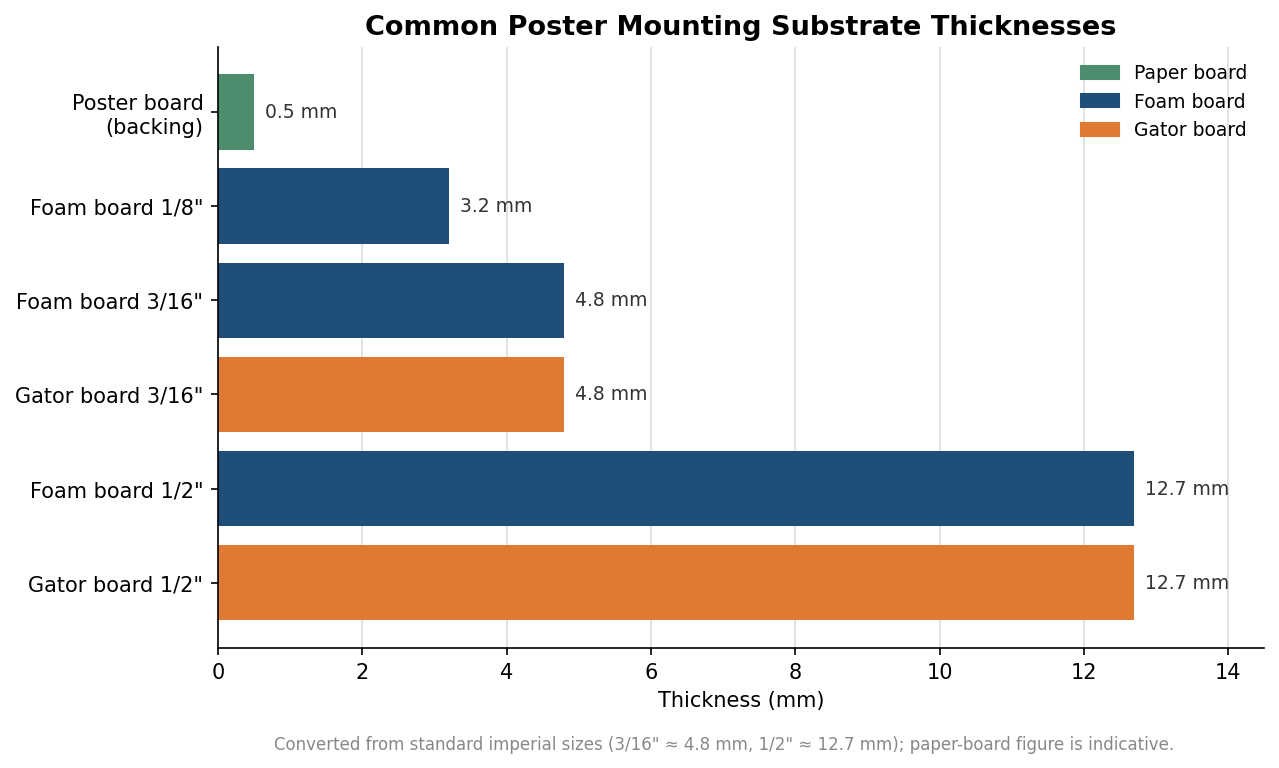
The thickness comparison above is worth internalizing when you order, because 3/16 inch is the default for both materials and the number most print shops assume unless you say otherwise. Step up to 1/2 inch when the panel is large enough that a thinner board would bow under its own weight, roughly once the longest side passes about 30 inches.
Hanging without a frame, without wrecking the wall
Damage-free adhesives are the default for renters and rotating displays. Removable mounting putty is the gentlest option and is ideal for lightweight prints on smooth walls, though it can leave a faint oil mark on very porous surfaces over time. Foam adhesive strips of the hook-and-loop type, sold specifically for posters and picture frames, hold more weight and peel away cleanly when stretched straight down; manufacturers rate them by weight, and those ratings are indicative rather than guaranteed, so err toward more strips than you think you need and press for the full recommended time. Low-tack painter’s tape and decorative washi tape work for very light, short-lived prints where a visible border is acceptable.
Hardware-based hangers add structure and a finished look. Magnetic wooden poster rails clamp the top and bottom edges and let you swap prints in seconds, which suits shops and studios that change artwork often. Simple binder clips on a nail, or a thin cable-and-clip rail system, carry heavier prints and keep the paper from sagging. None of these protect the poster surface, so pair them with a print you are comfortable exposing, or with lamination if the piece will be touched.
Lamination, dry mounting and surface protection
Lamination trades a little depth for a lot of durability. A matte or gloss film laminate seals the print against fingerprints, moisture and minor abrasion, and it stiffens a loose poster enough to survive handling. Gloss laminate deepens color and contrast but shows glare and smudges under direct light; matte laminate hides fingerprints and reads better on a bright wall at the cost of some punch. Either way, lamination is close to essential for a poster that people will physically handle, such as a menu or a display in a high-traffic entrance.
Dry mounting bonds the print permanently to a board. The poster is fused to foam board or gator board with a heat-activated adhesive tissue in a press, which drives out air, eliminates ripples, and holds the sheet dead flat. It is the cleanest way to get a museum-flat result, but it is not reversible, so it is the wrong choice for anything you might want to remove intact later. For rigid boards you can also finish the display with standoff hardware, small metal barrels that float the panel a fraction of an inch off the wall for a modern, dimensional look.
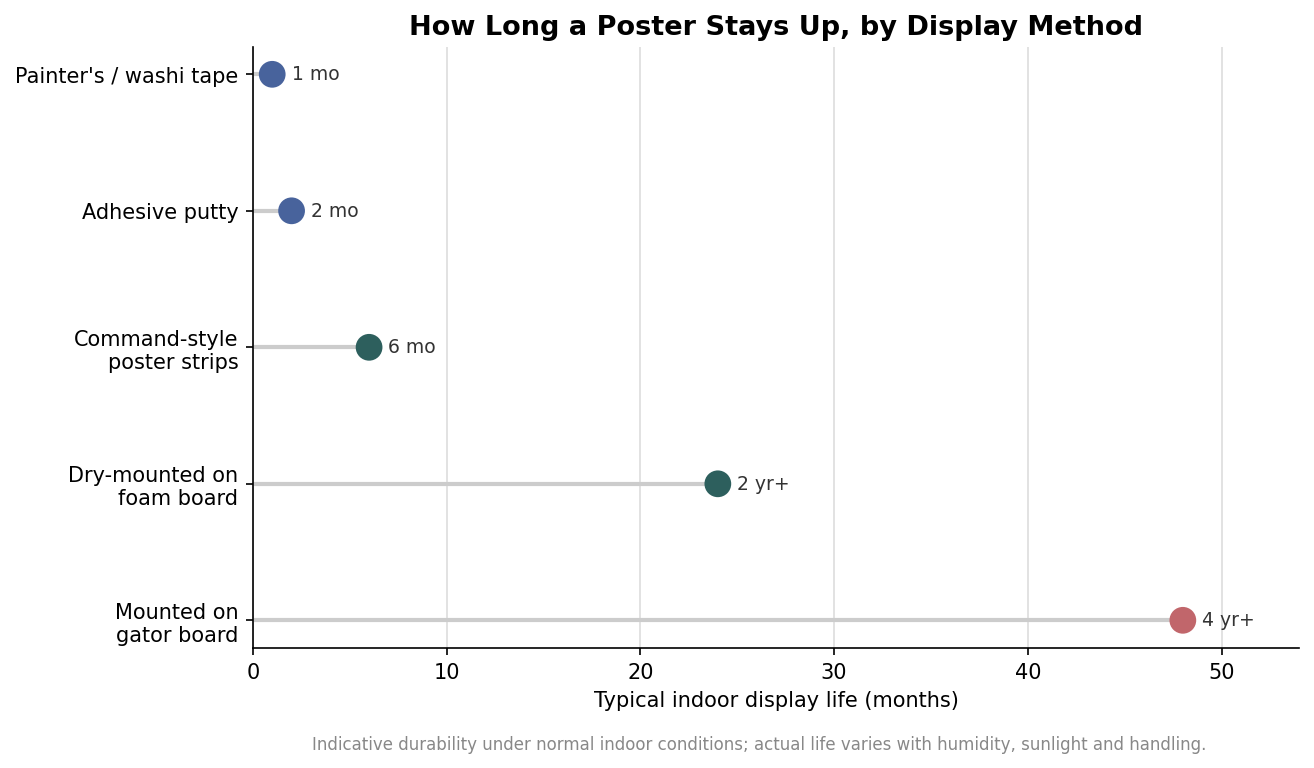
The durability figures above are indicative and assume ordinary indoor conditions, but the ranking is dependable: the more permanently a poster is bonded and backed, the longer it survives. A print held up by putty is a decoration for now; a print dry-mounted on gator board is a fixture.
How to specify it when you order
Give the print shop the whole picture in one shot. State the finished size, the substrate or mount you want, whether you want lamination and in what finish, and how you intend to hang it, because those choices interact. A large poster destined for standoffs needs a rigid gator-board mount; a rotating set of studio prints wants matte lamination and magnetic rails; a one-weekend event poster needs nothing more than the print and a pack of removable strips. Deciding these together, rather than ordering the print first and improvising the display later, is the difference between a poster that looks intentional and one that quietly curls off the wall. When in doubt, describe how long the piece needs to last and where it will hang, and let those two facts drive the rest.